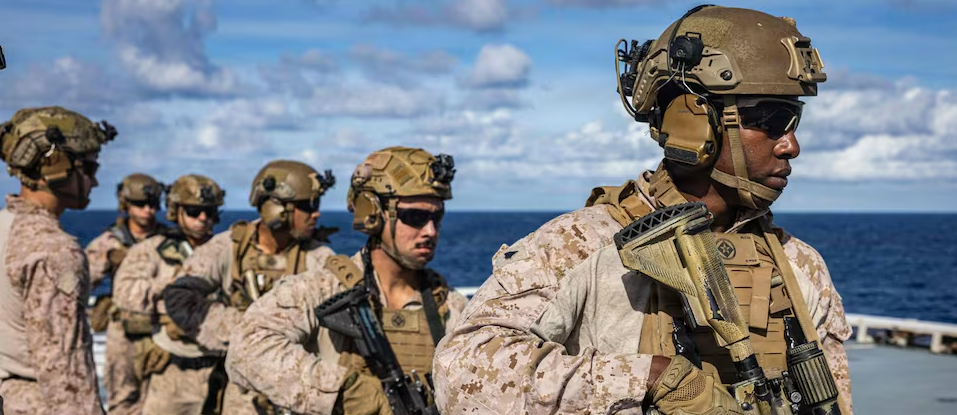

Tensions between the United States and Venezuela intensified this week after President Donald Trump confirmed that U.S. forces had seized a large oil tanker operating off the Venezuelan coast. The operation, which involved U.S. Marines descending from a helicopter onto the vessel, is part of Washington’s renewed pressure campaign against President Nicolás Maduro’s government.
According to U.S. officials, the tanker—identified as The Skipper—was transporting sanctioned crude from both Venezuela and Iran. The U.S. Department of Justice described the ship as part of an illicit “shadow fleet” designed to bypass international sanctions and financially support foreign terrorist organizations. The vessel had already been blacklisted by the U.S. Treasury in 2022 for allegedly assisting networks linked to Iran’s Islamic Revolutionary Guard Corps and Hezbollah.
Venezuela Condemns “Piracy”
Caracas reacted with fury. President Maduro denounced the seizure as “a blatant act of piracy and robbery,” accusing the United States of attempting to destabilize Venezuela and strip the country of its natural resources. Senior officials echoed the charge, with Interior Minister Diosdado Cabello calling the operation an “outrage against all Venezuelans” and labeling U.S. forces as “pirates and filibusters.”
The Venezuelan government announced plans to bring the incident before international bodies, arguing that U.S. military actions in the Caribbean constitute aggression and violate Venezuela’s sovereignty.
A Battle Over Oil and Influence
The seizure comes at a sensitive moment for Venezuela’s energy sector. Despite sweeping sanctions imposed in 2019, the country has managed to restore oil exports to nearly one million barrels per day by relying heavily on a “ghost fleet”—a global web of aging tankers that frequently change identity, disable tracking systems, and conduct ship-to-ship transfers on the high seas to obscure the origin of Venezuelan crude.
Washington’s escalation appears aimed at disrupting this network. Analysts say the deployment of U.S. naval and aerial assets in the Caribbean, including operations coordinated by the FBI, Homeland Security Investigations, and the Coast Guard, signals a strategic shift to directly target illicit maritime flows that underpin the Maduro government.
Regional and Global Implications
The incident has heightened geopolitical frictions not only between the U.S. and Venezuela but also among countries that provide flags, registries, or port access to shadow-fleet tankers. Transparency groups report that dozens of vessels operating off Venezuelan ports routinely deactivate their AIS tracking signals, with many sailing under flags from Panama, Comoros, and Malta—jurisdictions known for lighter oversight.
With Washington tightening enforcement and Caracas promising retaliation, observers warn that maritime confrontations may become more frequent in the coming weeks. The standoff also coincides with rising political pressure inside Venezuela, where opposition figures—including Nobel Peace Prize laureate María Corina Machado—continue to denounce the Maduro administration’s tactics and international dealings.